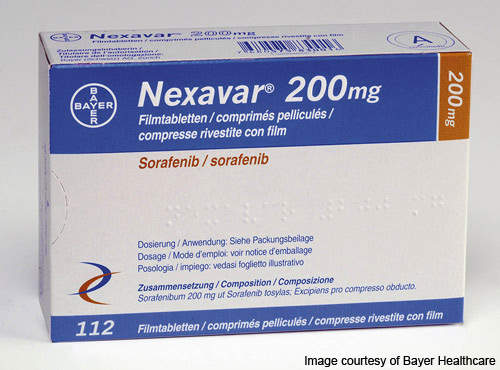

Nexavar is an oral anti-cancer agent that blocks cell proliferation and tumour angiogenesis. Developed by Bayer Healthcare with Onyx Pharmaceuticals, the drug obstructs the receptor tyrosine kinases – vascular endothelial growth factor receptor (VEGFR) VEGFR-2, VEGFR-3, platelet-derived growth factor receptor (PDGFR B), KIT, fms-related tyrosine kinase 3 (FLT-3) and RET – along the signalling pathways.
Approved by the US Food and Drug Administration in December 2005 and 2007 for the treatment of kidney cancer and liver cancer respectively, Nexavar belongs to a new category of drugs called signal transduction inhibitors. The drug is available in 80 countries for the treatment of liver cancer and in 90 countries for kidney cancer treatment.
Recommended White Papers

Recommended Buyers Guides

Bayer and Onyx received approval for Nexavar from the FDA for the treatment of patients with locally recurrent or metastatic, progressive, differentiated thyroid carcinoma (DTC) refractory to radioactive iodine treatment in November 2013.
Bayer and Onyx received positive opinion from the European Committee for Medicinal Products for Human Use (CHMP) recommending approval of Nexavar for the treatment of patients with progressive, locally advanced or metastatic, differentiated thyroid carcinoma, refractory to radioactive iodine in April 2014. The drug was previously granted an orphan drug designation for the treatment of follicular and papillary thyroid cancer by the European Commission in November 2013.
Targeting liver and kidney cancer
Worldwide, cancer is one of the leading causes of death among adults. According to statistics of the World Health Organization, nearly 7.9 million people had died because of cancer in 2007. Used as a generic term for a number of diseases, cancer can affect any body part. The most common cancers are those affecting the lung, stomach, liver and colon.
The sixth most common cancer, liver cancer kills approximately 610,000 people every year globally. In 2009, according to the American Cancer Society’s estimates, 22,000 new cases of primary liver cancer will be diagnosed in the US alone.
Kidney cancer, also known as renal cell carcinoma (RCC), is listed among the world’s ten most common cancers. According to the American Cancer Society, throughout 2009 57,760 new cases of kidney cancer will be diagnosed, of which 12,980 are estimated to result in death.
Thyroid cancer is the most common endocrine malignancy, which affects more than 298,000 people and causes about 40,000 deaths annually worldwide.
Nexavar inhibits cell growth and the formation of tumour angiogenesis by working along the multiple signalling pathways.
Nexavar blocks the receptor tyrosine kinases (RKT) including VEGFR, PDGFR and the RAF serine/threonine kinases involved in the RAF/MEK/ERK pathway. By obstructing VEGF and PDGF receptors at the upstream and simultaneously blocking the downstream of the RAF/MEK/ERK pathway, Nexavar reduces angiogenesis and tumour cell multiplication at the same time.
Patients are given a daily dose of 400mg (2x200mg tablets) at a minimum gap of one hour before or two hours after taking food. The treatment is continued until patients stop showing any clinical benefits from the treatment. The treatment is also stopped when the toxicity reaches unacceptable levels. Fatigue, weight reduction, rash/desquamation, reaction of the hand or foot skin, alopecia, diarrhoea, anorexia, nausea and pain in the abdomen are the most common adverse reactions arising due to Nexavar in more than 20% of the cases.
Until Nexavar was approved, patients suffering from liver and kidney cancer had limited treatment options. Nexavar was approved for the treatment of advanced kidney cancer in 2005. Patients who have undergone prior interferon-alpha or interleukin-2 based therapy and have failed to experience any positive result or those patients who are found unsuitable for such therapies are considered for a Nexavar-based treatment.
Clinical trial results point to survival advantages
The clinical efficacy and safety of Nexavar has been proven in a series of clinical trials conducted over a period of time. In a large-scale Phase III clinical trial involving nearly 900 patients conducted on advanced kidney cancer, Nexavar was found to be well tolerated and possess major survival advantages. With Nexavar, the average progression-free survival of patients increased to 24 weeks in comparison to 12 weeks demonstrated by patients taking placebo.
For HCC, the results from a Phase III placebo-controlled Sorafenib HCC Assessment Randomized Protocol (SHARP) trial showed that Nexavar improved the overall survival of patients by 44% over those taking placebo.
On average, patients treated with Nexavar had an overall survival of 10.7 months in comparison to 7.9 months witnessed by placebo-treated patients.
The FDA approval for Nexavar for the treatment of thyroid cancer was based on a phase III clinical trial known as DECISION (stuDy of sorafEnib in loCally advanced or metastatIc patientS with radioactive Iodine refractory thyrOid caNcer) trial. The international, multicenter, placebo-controlled study was conducted in 77 centres across 18 countries worldwide. The study enrolled 417 patients with locally advanced or metastatic, progressive, RAI-refractory, differentiated thyroid cancer.
The primary endpoint of the study was progression-free survival (PFS)., whereas the secondary endpoints included overall survival (OS), tumour response rate, duration of response, and the safety and tolerability of the drug.
The results demonstrated that the patients treated with Nexavar met the primary endpoint. The patients administered with Nexavar showed a 41% reduction in the risk of progression or death when compared to placebo-treated patients. The median PFS was 10.8 months in patients treated with Nexavar, compared to 5.8 months in patients receiving placebo.
The most common adverse reactions found in the patients treated with Nexavar included Palmar-plantar erythrodysesthesia syndrome, diarrhoea, alopecia, weight loss, fatigue, hypertension, rash, and decreased appetite.
Forthcoming clinical trials
Multiple clinical trials of Nexavar on patients with liver and kidney cancer are underway. Nexavar is undergoing Phase III trials to compare the efficacy of Nexavar versus Pfizer’s sunitinib versus placebo for adjuvant setting in kidney cancer. It is also undergoing a Phase II study in combination with Genentech/Roche’s bevacizumab and Wyeth Pharmaceuticals’ temsirolimus for the treatment of advanced RCC.
To compare the effectiveness of Nexavar as an adjuvant treatment in liver cancer, the company is enrolling patients for a randomised, double-blind, placebo-controlled Phase III trial. The trial will determine Nexavar’s efficacy in combination with erlotinib for treating patients suffering from liver cancer that is unresectable, advanced, metastatic or is classified as Child-Pugh, a type of liver cancer.